
African garments, like the Melhfa, have long transcended borders, shaping the aesthetic vocabulary of global fashion. Yet the question remains: how often are these iconic staples properly contextualized within their cultural origins?
Many African artists, such as Daoud Aoulad-Syad, have drawn inspiration from the Melhfa. His work focused on men and women from the south of Morocco, proudly draped in what they consider their traditional attire.

Unsurprisingly, the garment’s unique silhouette has also influenced prominent international artists like Irving Penn, who photographed Les Femmes de Guelmim in 1971, and Hervé Nègre, whose 2013 book El Melhfa: Drapés Féminins du Maroc Saharien was published as a tribute to the garment’s visual richness.

These interpretations, often filtered through a Eurocentric lens, nonetheless contributed to a visual legacy that gave the Melhfa renewed life, ushering it from tradition to the world of fashion photography, and eventually onto global runways where the garment continues to be reimagined.
Born in Oran, Algeria, in 1936 during the French colonial period, Yves Saint-Laurent’s creative process was deeply shaped by his opposition to the occupation of Algeria. His layered relationship with the African continent led to several of his legendary works, including his Spring/Summer 1967 “Africa Collection”, also referred to as the “Bambara Collection”, a tribute featuring wooden beads, raffia, straw, and golden thread.

Katoucha in Yves Saint-Laurent – SS67
He was also one of the few Western designers of his era to consistently cast Black models in his shows. His muses, including Imaan and Katoucha, were more than just models; they were cultural vessels. Their presence infused his creations with layers of personal meaning and symbolism, introducing codes and beliefs drawn from their lived experiences and heritage.
Beginning in 1966, Saint-Laurent spent extended periods in Marrakech, a city that would become a refuge and source of inspiration for his designs and personal life. The city’s significance was so central to his creative process that in 2017, the Musée Yves Saint-Laurent Marrakech was inaugurated, where his archives continue to be studied and referenced.
Throughout the years, the hooded dress, also known as the capuche, became one of the staples of the YSL house. First introduced in 1969 through a collaboration with sculptor Claude Lalanne, it reappeared in 1985, 2002, and again in 2008.

The capuche’s draped texture, elongated hood, and theatrical veil closely mirror the flowing silhouettes of the Melhfa. In 2023, under the creative direction of Anthony Vaccarello, the hooded dress evolved once more. He described his version as a “prolongation of fabric over the model’s head,” drawing inspiration from the “tubular sheaths” worn by choreographer Martha Graham.
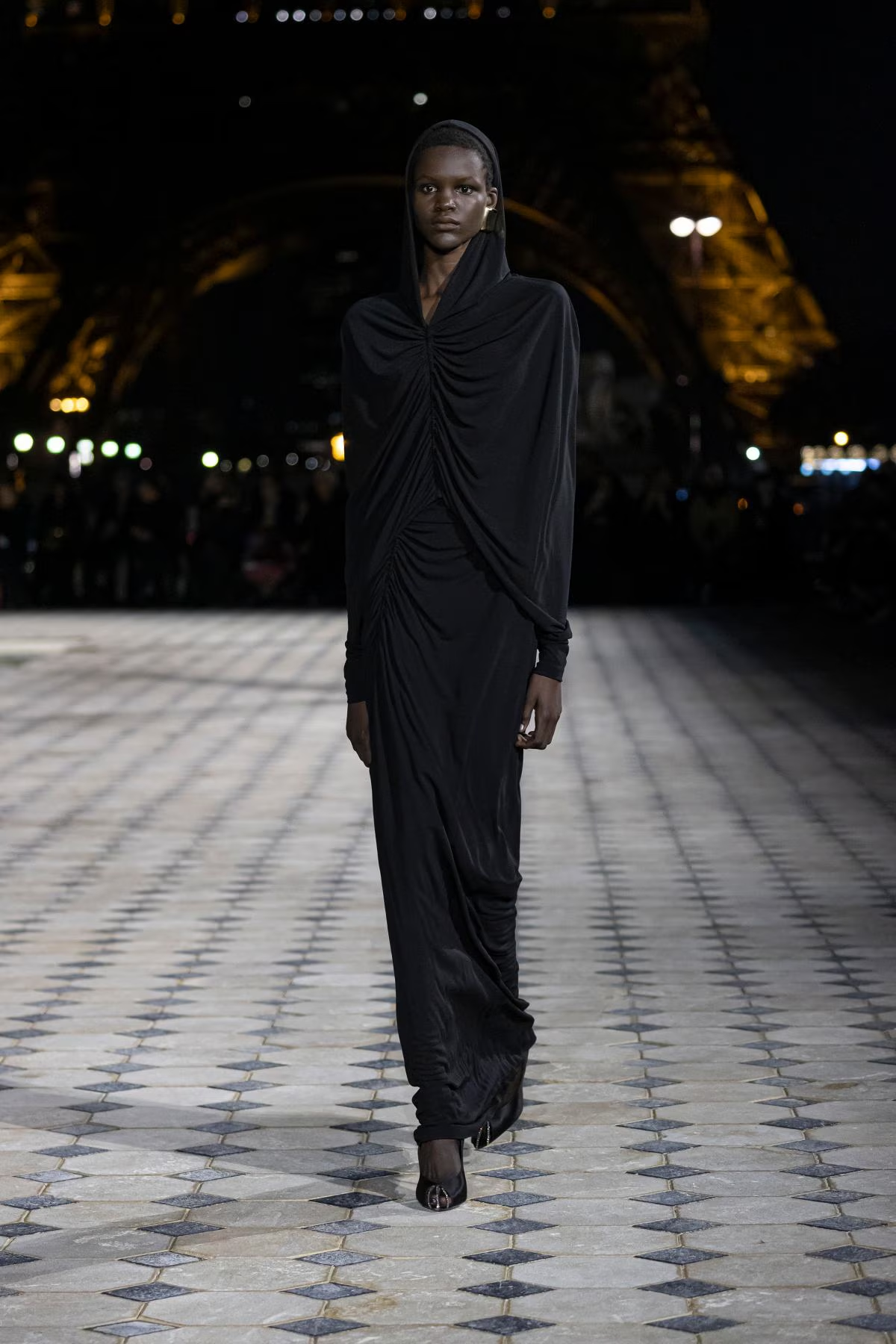
Thus, an important observation emerges: the YSL design language continues to draw inspiration from archival pieces that themselves referenced the Continent, sometimes subtly, and other times overtly. Therefore, recent collections could benefit from a deeper cultural contextualization.
 FAD
FAD 